Articles - "Chimamanda Adichie"
Showing posts with label Chimamanda Adichie. Show all posts
Loladeville blog is a one-stop site for entertainment, sports, fashion and other interesting news.

I'm certain only a very small fraction of the "world" know that accomplished writer, Chimamanda Adichie is now a mum. Infact, but for a recent interview with a Financial Times journalist, this exciting information wouldn't have become public knowledge. So, Chimamanda is now a mother to a girl. We are surprised and in awe. 


She told the journalist, ‘this is the first time I’m saying it publicly. I have a little girl. I have some friends who probably don’t know I was pregnant or that I had a baby, I just feel like we live in an age when women are supposed to perform pregnancy. We don’t expect fathers to perform fatherhood. I went into hiding. I wanted it to be as personal as possible’.
Loladeville blog is a one-stop site for entertainment, sports, fashion and other interesting news.
Come May 18, 2016, Award-winning Nigerian novelist, Chimamanda Adichie and 7 other distinguished achievers will be conferred with honorary degrees from America's first research university, Johns Hopkins University,  Maryland. The prolific writer will receive the honour at the universitywide commencement ceremony taking place at Royal Farms Arena. 
John Hopkins honorary_degrees_0
Other recipients include Richard Axel (Nobel Prize recipient), Susan Baker (Founder of the Johns Hopkins Center for Injury Research and Policy), Ellen M. Heller, (The first woman appointed to be Maryland’s Administrative Circuit Court judge), Shelton Jackson (Spike) Lee (Acclaimed filmmaker), Judith Rodin (President, Rockefeller Foundation), Shale Stiller (Eminent Trial Attorney) and Laurie Zabin (Founding director of the Bill and Melinda Gates Institute for Population and Reproductive Health)
Johns Hopkins University President, Ronald J. Daniels described the honorees as "The men and women in this group are visionaries who have challenged the status quo and changed the world for the better. They have made a lasting impact on the arts, public health, the law, neuroscience, and the resilience of communities here in Baltimore and across the globe. At Johns Hopkins, we share their commitment to innovate and to work for the benefit of humankind, and I’m so pleased that these honorary degrees will celebrate all they have accomplished.”


Source: Olisa.tv 
Loladeville blog is a one-stop site for entertainment, sports, fashion and other interesting news.
Nigerian literary icon, Chimamanda Ngozi Adichie has been awarded the "Best of the Best" of the winners of the second decade of the Bailey's Women's Prize for Fiction. The announcement was made at the Pic­cadilly Theatre in London on Monday. Half of a Yellow Sun won the prize in 2007
Formerly called Orange Prize for fiction, the Baileys Women's Prize for Fiction which was established in 1996, is awarded to the best novel of the year written by a woman. The award category is part of the celebrations to mark 20 years of the annual £30,000 prize.

Speaking on the award, the 38-year-old said "I have a lot of respect for the books that have won awards in the past 10 years and also for the books that have been short­listed – I feel I am in very good company. To be selected as 'Best of the Best' of the past decade is such an honour. I'm very grateful and very happy."

Other winners of the Baileys Prize from the last decade include Zadie Smith for On Beauty and Eimear McBride for A Girl is a Half-formed Thing.
Loladeville blog is a one-stop site for entertainment, sports, fashion and other interesting news.

How softly the rain fell that Monday morning when my water broke. Because I was used to the raging downpours of Lagos, this quiet patter calmed me, filled me with peace. My husband Omoregie was at work and so our neighbor took me to the hospital, my dress slightly damp, my heart full of expectation. My firstborn child.

The nurse on duty was Sister Chioma, a woman with an unsmiling face who liked to crack sharp-tongued jokes. During my last check up, when I complained about the backache brought on by my pregnancy, her retort was, "Did you think about backache when you were enjoying it?"

She checked my cervix and told me it was early. She encouraged me to walk up and down the ward.
"You must be happy that your first is a boy," she said.

I shrugged. "As long as the baby is healthy."


"I know you are supposed to wait until he is born to decide on a name but I'm sure you already have something in mind," she said.

"I will name him Olikoye."


" Oh." She paused. "I didn't know your husband was Yoruba."


"He's not. We're both Bini."

"But Olikoye is a Yoruba name."

"Yes it is."

"Why?" she asked. My contractions were slow. I told Sister Chioma to sit down and I would tell her the story.


My father's first child was a girl. He said she was a loud squalling baby who grasped his finger with surprising strength, and he knew it meant she would be tough. But she died at the age of four months. The second, a boy, was not yet four months old before he died. Some people from my father's family said my mother was a witch, eating her children, trading their innocent hearts in exchange for her own long life. But, at that time, other babies in our village in Edo were dying too. They got sick with watery shit and weak eyes. Some people said the diarrhea was punishment from God. The Christians prayed in church. The Muslims prayed at the mosque. The old people performed sacrifices. Still, babies died, and their tiny still bodies were wrapped in cloth and buried, and it seemed senseless that they had even been born at all.


It was 1985. My father was working as a driver at the Ministry of Health. He was in the general pool, a lowly position. One day, he picked up a visiting dignitary from the airport, dropped him at his hotel, and then discovered, lodged in the back seat of the car, a thick envelope of cash that had slid out of the man's bag. He returned it immediately. The man was so pleased — and surprised—that he told the new Minister of Health about it. Two days later, the new Minister asked for my father. "I want you to be my driver," The Minister said. "I value honesty."

The Minister's name was Dr. Olikoye Ransome-Kuti. He had big sleepy eyes and seemed to come from another time in the past when old-fashioned integrity was easy. His simplicity surprised my father. He was not interested in the usual carousing of the powerful, no late nights and drinking and trysts, and my father did not have to guard any secrets for him. He ate breakfast with his family every morning, and took walks with his wife in the evening, and played tennis with his children on weekends. He listened attentively, those half-closed eyes so intent that my father, at first, felt uncomfortable when they were trained on him.

The Minister asked my father about his family, and my father told him everyone was fine. The Minister asked how many children he had, and my father said none yet, but that his wife was pregnant and due in a few weeks. (My mother was pregnant with me.) 

Then the minister asked a question that startled my father. "How many of your children have died?"

My father stuttered and said, "Two, sir, but we are praying that it will not happen again." The Minister told him it was good to pray, but there was something else he had to do. 

"Our children are dying of simple illnesses and that must stop. I want you to take me to your village. I have started a program in Lagos but I want to start others in different parts of the country. We will go to your village next week." 

It took my heavy-tongued father a while to find his voice and say, "Yes sir."

In my father's village, the Minister walked around with his assistants, meeting people and asking them questions and listening to them. He showed women how to mix sugar and salt and clean water to give their children who had diarrhea and he told them about washing their hands with soap and he told them the Universal Primary Health Care center would be open in a month. Once it was open, every baby would receive vaccines.
He showed them photographs of bright-eyed babies in Lagos and he told them immunizations were like small precious gifts for babies. They cheered and clapped. In the eyes of the villagers, my father was a star. No minister had ever come to them before.

Who even knew that our small village existed? But my father kept telling them that he had done nothing, that it was the minister who insisted on coming. Years later, when my father told me the story, I could still see his eyes full of things I could not name.

"The Minister treated all of us like human beings," he said. 

"Like human beings."

It took mere moments. A baby's small open mouth and a drop of liquid. A baby's warm arm and a small injection. It took that to save the lives of the babies born that year in my village, and in the villages around us and those far from us, in Calabar and Enugu and Kaduna. It took that to save my life. I was born in 1986. I often tried to imagine myself being immunized, in my mother's arms, in the new clinic the minister built. Women filled the passages. The treatment was free. At the other end was the family planning unit where nurse was talking to a roomful of women, sometimes making jokes that made them laugh. My mother joined them.

Years later, she told me that the reason I did not die was that small injection in my arm, but the reason I was able to go to school was family planning. My sister was born two years after me, and my brother two years after her, and my mother remembered the words of the family planning nurse who told her to "have the number of children that you can train well. Otherwise you will not be able to train even one of them well."

Because of the Minister, my father came to know Nigeria well. The Minister went to other interior villages and towns, and my father drove him through the flat roads of the North and the undulating roads of the south. He followed the Minister to the clinics, watched him speaking, gesticulating, explaining, cutting ribbons to open health centers.

Everywhere they went, people followed the Minister. Some just wanted to touch him, to shake his hands. Others brought gifts. 

"No, no," the minister said to my father, when he saw the yams and plantains and chickens. ‎

"Give it back to them. Tell them that they should keep it for me."

I first met the Minister when I was six years old. I was in Primary One, and my father told him I came first in class and the Minister asked him to bring me to his house. I expected to wait in the kitchen, and felt awkward to be asked into the living room, into the sinking softness of the carpet and the smell of clean and new things. He appeared with his wife, both of them smiling. They gave me a book. A Childs Illustrated Book About The Body.

"Thank you, sir, thank you, ma," I said, holding the book tighter than I had ever held anything in my young life.

Sister Chioma was squeezing my hand.
"So you knew him personally," she said. "I finished nursing school the year he was appointed Minister."

Her tone was different, less flat, more emotional. It was then I noticed that Sister Chioma, unsmiling, hard Sister Chioma, had tears in her eyes.


"It was because of Olikoye Ransome-Kuti that so many people in Nigeria did not die," she said quietly, and I knew she had her own story about the Minister. Perhaps she would tell me the story later, or perhaps she would not, but it pleased me that we had a story in common.

"He was the best health minister this country has ever had," she said, standing up and hastily wiping her eyes. My contractions were now shorter and sharper. Sister Chioma said it was perhaps time to push, and she got up to call the doctor.
Outside the rain continued to fall gently until Olikoye was born.


*******************************************************************************************************************************
Chimamanda is a Nigerian novelist, nonfiction writer and short story writer.‎ She is the author of three novels, Purple Hibiscus (2003), Half of a Yellow Sun (2006), and Americanah (2013), of a short story collection, The Thing around Your Neck (2009).


********************************************************************************************************************************
Are you a writer? Interested in sharing your short stories on this platform? Be our guest on our Short Story Fridays segment.

Email: loladevilleblog@gmail.com/ololade.olatunji@yahoo.com 
‎


Loladeville blog is a one-stop site for entertainment, sports, fashion and other interesting news.
My father was kidnapped in Nigeria on a Saturday morning in early May. My brother called to tell me, and suddenly there was not enough breathable air in the world. My father is 83 years old. A small, calm, contented man, with a quietly mischievous humor and a luminous faith in God, his beautiful dark skin unlined, his hair in sparse silvery tufts, his life shaped by that stoic, dignified responsibility of being an Igbo first son.

He got his doctoral degree at Berkeley in the 1960s, on a scholarship from the United States Agency for International Development; became Nigeria's first professor of statistics; raised six children and many relatives; and taught at the University of Nigeria for 50 years. Now he makes fun of himself, at how slowly he climbs the stairs, how he forgets his cellphone. He talks often of his childhood, endearing and rambling stories, his words tender with wisdom.

Sometimes I record his Igbo proverbs, his turns of phrase. A disciplined diabetic, he takes daily walks and is to be found, after each meal, meticulously recording his carbohydrate grams in a notebook. He spends hours bent over Sudoku. He swallows a handful of pills everyday. His is a generation at dusk.

On the morning he was kidnapped, he had a bag of okpa, apples and bottled water that my mother had packed for him. He was in the back seat of his car, his driver at the wheel, on a lonely stretch between Nsukka, the university town where he lives, and Abba, our ancestral hometown. He was going to attend a traditional meeting of men from his age group. A two-hour drive. My mother was planning their late lunch upon his return: pounded yam and a fresh soup. They always called each other when either traveled alone. This time, he didn't call. She called him and his phone was switched off. They never switched off their phones. Hour after hour, she called and it remained off. Later, her phone rang, and although it was my father's number calling, a stranger said, "We have your husband."

Kidnappings are not uncommon in southeastern Nigeria and, unlike similar incidents in the Niger Delta, where foreigners are targeted, here it is wealthy or prominent local residents. Still, the number of abductions has declined in the past few years, which perhaps is why my reaction, in the aftermath of my shock, was surprise.

My close-knit family banded together more tightly and held vigil by our phones. The kidnappers said they would call back, but they did not. We waited. The desire to urge time forward numbed and ate my soul. My mother took her phone with her everywhere, and she heard it ringing when it wasn't. The waiting was unbearable. I imagined my father in a diabetic coma. I imagined his octogenarian heart collapsing.

"How can they do this violence to a man who would not kill an ant?" my mother lamented. My sister said, "Daddy will be fine because he is a righteous man." Ordinarily, I would never use "righteous" in a non-pejorative way. But something shifted in my perception of language. The veneer of irony fell away. It felt true. Later, I repeated it to myself. My father would be fine because he was a "righteous man."

I understood then the hush that surrounds kidnappings in Nigeria, why families often said little even after it was over. We felt paranoid. We did not know if going public would jeopardize my father's life, if the neighbors were complicit, if another member of the family might be kidnapped as well.

"Is my husband alive?" my mother asked, when the kidnappers finally called back, and her voice broke. "Shut up!" the male voice said. My mother called him "my son." Sometimes, she said "sir." Anything not to antagonize him while she begged and pleaded, about my father being ill, about the ransom being too high. How do you bargain for the life of your husband? How do you speak of your life partner in the deadened tone of a business transaction?

"If you don't give us what we want, you will never see his dead body," the voice said.

My paternal grandfather died in a refugee camp during the Nigeria-Biafra war and his anonymous death, his unknown grave, has haunted my father's life. Those words — "You will never see his dead body" — shook us all.

Kidnapping's ugly psychological melodrama works because it trades on the most precious of human emotions: love. They put my father on the phone, and his voice was a low shadow of itself. "Give them what they want," he said. "I will not survive if I stay here longer." My stoic father. It had been three days but it felt like weeks.

Friends called to ask for bank-account details so they could donate toward the ransom. It felt surreal. Did it ever feel real to anybody in such a situation, I wondered? The scramble to raise the money in one day. The menacingly heavy bag of cash. My brother dropping it off, through a circuitous route, in a wooded area.

Late that night, my father was taken to a clearing and set free.

While his blood sugar and pressure were checked, my father kept reassuring us that he was fine, thanking us over and over for doing all we could. This is what he knows how to be — the protector, the father — and he slipped into his role almost as a defense. But there were cracks in his spirit. A drag in his gait. A bruise on his back.

"They asked me to climb into the boot of their car," he said. "I was going to do so, but one of them picked me up and threw me inside. Threw. The boot was full of things and I hit my head on something. They drove fast. The road was very bumpy."

I imagined this grace-filled man crumpled inside the rear of a rusty car. My rage overwhelmed my relief — that he suffered such an indignity to his body and mind.

And yet he engaged them in conversation. "I tried to reach their human side," he said. "I told them I was worried about my wife."

The next day, my parents were on a flight to the United States, away from the tainted blur that Nigeria had become.

With my father's release, we all cried, as though it was over. But one thing had ended and another begun. I constantly straddled panic; I was sleepless, unfocused, jumpy, fearful that something else had gone wrong. And there was my own sad guilt: He was targeted because of me. "Ask your daughter the writer to bring the money," the kidnappers told him, because to appear in newspapers in Nigeria, to be known, is to be assumed wealthy. The image of my father shut away in the rough darkness of a car boot haunted me. Who had done this? I needed to know.

But ours was a dance of disappointment with the authorities. We had reported the kidnapping immediately, and the first shock soon followed: State security officials asked us to pay for anti-kidnap tracking equipment, a large amount, enough to rent a two-bedroom flat in Lagos for a year. This, despite my being privileged enough to get personal reassurances from officials at the highest levels.

How, I wondered, did other families in similar situations cope? Federal authorities told us they needed authorization from the capital, Abuja, which was our responsibility to get. We made endless phone calls, helpless and frustrated. It was as though with my father's ransomed release, the crime itself had disappeared. To encounter that underbelly, to discover the hollowness beneath government proclamations of security, was jarring.

Now my father smiles and jokes, even of the kidnapping. But he jerks awake from his naps at the sound of a blender or a lawn mower, his eyes darting about. He recounts, in the middle of a meal, apropos of nothing, a detail about the mosquito-filled room where he was kept or the rough feel of the blindfold around his eyes. My greatest sadness is that he will never forget.


Credit: New York Times 


Loladeville blog is a one-stop site for entertainment, sports, fashion and other interesting news.
Professor James Nwoye Adichie, the father of renowned writer and author Chimamanda Adichie who was kidnapped on Saturday May 2, 2015, has been freed by his abductors.

The 83 year-old was travelling from Nsukka to his hometown Abba, in Anambra state when the kidnappers abducted him and his driver. The sum of $250, 000 was later demanded  for his release.

Professor Adichie was released at about 8pm last night but what however cannot be ascertained is whether the family paid the ransom.

Prof Adichie is the first professor of statistics in Nigeria and was Deputy Vice-Chancellor of the University of Nigeria Nsukka (UNN).
Loladeville blog is a one-stop site for entertainment, sports, fashion and other interesting news.

"A few days ago, the Oba of Lagos threatened Igbo leaders. If they did not vote for his governorship candidate in Lagos, he said, they would be thrown into the lagoon. His entire speech was a flagrant performance of disregard. 

His words said, in effect: I think so little of you that I don't have to cajole you but will just threaten you and, by the way, your safety in Lagos is not assured, it is negotiable.

There have been condemnations of the Oba's words. Sadly, many of the condemnations from non-Igbo people have come with the ugly impatience of expressions like 'move on,' and 'don't be over-emotional' and 'calm down.' 

These take away the power, even the sincerity, of the condemnations. It is highhanded and offensive to tell an aggrieved person how to feel, or how quickly to forgive, just as an apology becomes a non-apology when it comes with 'now get over it.'

Other condemnations of the Oba's words have been couched in
dismissive or diminishing language such as 'The Oba can't really do anything, he isn't actually going to kill anyone. He was joking. He was just being a loudmouth.'

Or – the basest yet – 'we are all prejudiced.' It is dishonest to
respond to a specific act of prejudice by ignoring that act and
instead stressing the generic and the general. It is similar to responding to a specific crime by saying 'we are all capable of crime.' Indeed we are. 

But responses such as these are diversionary tactics. They dismiss the specific act, diminish its importance, and ultimately aim at silencing the legitimate fears of people.

We are indeed all prejudiced, but that is not an appropriate response to an issue this serious. The Oba is not an ordinary citizen. He is a traditional ruler in a part of a country where traditional rulers command considerable influence – the reluctance on the part of many to directly chastise the Oba
speaks to his power. 

The Oba's words matter. He is not a singular voice; he represents traditional authority. The Oba's words matter because they are enough to incite violence in a political setting already fraught with uncertainty. The Oba's words matter even more in the event that Ambode loses the governorship election, because it would then be easy to scapegoat Igbo people and hold them punishable.

Nigerians who consider themselves enlightened might dismiss the Oba's words as illogical. But the scapegoating of groups – which has a long history all over the world – has never been
about logic. The Oba's words matter because they bring
worrying echoes of the early 1960s in Nigeria, when Igbo people were scapegoated for political reasons. 

Chinua Achebe, when he finally accepted that Lagos, the city he called home, was unsafe for him because he was Igbo, saw crowds at the motor park taunting Igbo people as they boarded buses: 'Go,
Igbo, go so that garri will be cheaper in Lagos!'

Of course Igbo people were not responsible for the cost of garri.
But they were perceived as people who were responsible for a coup and who were 'taking over' and who, consequently, could be held responsible for everything bad.

Any group of people would understandably be troubled by a
threat such as the Oba's, but the Igbo, because of their history in Nigeria, have been particularly troubled. And it is a recent history. 

There are people alive today who were publicly attacked in cosmopolitan Lagos in the 1960s because they were Igbo. Even people who were merely light-skinned were at risk of violence in Lagos markets, because to be light-skinned was to be mistaken for Igbo.

Almost every Nigerian ethnic group has a grouse of some sort
with the Nigerian state. The Nigerian state has, by turns, been
violent, unfair, neglectful, of different parts of the country. 

Almost every ethnic group has derogatory stereotypes attached to it by other ethnic groups. But it is disingenuous to suggest that the experience of every ethnic group has been the same. 

Anti-Igbo violence began under the British colonial government, with complex roots and manifestations. But the end result is a certain psychic difference in the relationship of Igbo people to the Nigerian state. 

To be Igbo in Nigeria is constantly to be suspect; your national patriotism is never taken as the norm, you are continually expected to prove it.

All groups are conditioned by their specific histories. Perhaps
another ethnic group would have reacted with less concern to the Oba's threat, because that ethnic group would not be conditioned by a history of being targets of violence, as the Igbo have been.

Many responses to the Oba's threat have mentioned the
'welcoming' nature of Lagos, and have made comparisons between Lagos and southeastern towns like Onitsha. It is valid to debate the ethnic diversity of different parts of Nigeria, to compare, for example, Ibadan and Enugu, Ado-Ekiti and Aba, and to debate who moves where, and who feels comfortable
living where and why that is. 

But it is odd to pretend that Lagos
is like any other city in Nigeria. It is not. The political  history of Lagos and its development as the first national capital set it apart. Lagos is Nigeria's metropolis. There are ethnic Igbo people whose entire lives have been spent in Lagos, who have little or no ties to the southeast, who speak Yoruba better than Igbo. Should they, too, be reminded to be 'grateful' each time an election draws near?

No law-abiding Nigerian should be expected to show gratitude for living peacefully in any part of Nigeria. Landlords  in Lagos should not, as still happens too often, be able to refuse to rent their property to Igbo people.

The Oba's words were disturbing, but its context is even more
disturbing:

The anti-Igbo rhetoric that has been part of the political discourse since the presidential election results.  Accusatory and derogatory language – using words like 'brainwashed,' 'tribalistic voting' – has  been used to describe President Jonathan's overwhelming win in the southeast. 

All democracies have regions that vote in large numbers for one side, and even though parts of Northern Nigeria showed voting patterns similar to the Southeast, the opprobrium has been reserved for the Southeast.

But the rhetoric is about more than mere voting. It is really about citizenship. To be so entitled as to question the legitimacy of a people's choice in a democratic election is not only a sign of disrespect but is also a questioning of the full citizenship of those people.

What does it mean to be a Nigerian citizen? When Igbo people are urged to be 'grateful' for being in Lagos, do they somehow have less of a right as citizens to live where
they live? Every Nigerian should be able to live in any part of Nigeria.

 The only expectation for a Nigerian citizen living in any part of Nigeria is to be law-abiding. Not to be 'grateful.' Not to be expected to pay back some sort of unspoken favour by toeing a particular political line. Nigerian citizens can vote for whomever they choose, and should never be expected to justify or apologize for their choice.

Only by feeling a collective sense of ownership of Nigeria can we start to forge a nation. A nation is an idea. Nigeria is still in progress. To make this a nation, we must collectively agree on what citizenship means: all Nigerians must matter equally."


Credit: www.olisa.tv


Loladeville blog is a one-stop site for entertainment, sports, fashion and other interesting news.
Last week, Victor, a carpenter, came to my Lagos home to fix a broken chair. I asked him whom he preferred as Nigeria's next president: the incumbent, Goodluck Jonathan, or his challenger, Muhammadu Buhari.

"I don't have a voter's card, but if I did, I would vote for somebody I don't like," he said. "I don't like Buhari. But Jonathan is not performing."

Victor sounded like many people I know: utterly unenthusiastic about the two major candidates in our upcoming election.

Were Nigerians to vote on likeability alone, Jonathan would win. He is mild-mannered and genially unsophisticated, with a conventional sense of humor. Buhari has a severe, ascetic air about him, a rigid uprightness; it is easy to imagine him in 1984, leading a military government whose soldiers routinely beat up civil servants. 

Neither candidate is articulate. Jonathan is given to rambling; his unscripted speeches leave listeners vaguely confused. Buhari is thick-tongued, his words difficult to decipher. In public appearances, he seems uncomfortable not only with the melodrama of campaigning but also with the very idea of it.

To be a democratic candidate is to implore and persuade, and his demeanor suggests a man who is not at ease with amiable consensus. Still, he is no stranger to campaigns. This is his third run as a presidential candidate; the last time, in 2011, he lost to Jonathan.

This time, Buhari's prospects are better. Jonathan is widely perceived as ineffectual, and the clearest example, which has eclipsed his entire presidency, is his response to Boko Haram. Such a barbaric Islamist insurgency would challenge any government.

But while Boko Haram bombed and butchered, Jonathan seemed frozen in a confused, tone-deaf inaction. Conflicting stories emerged of an ill-equipped army, of a corrupt military leadership, of northern elites sponsoring Boko Haram, and even of the government itself sponsoring Boko Haram.

Jonathan floated to power, unprepared, on a serendipitous cloud. He was a deputy governor of Bayelsa state who became governor when his corrupt boss was forced to quit. Chosen as vice president because powerbrokers considered him the most harmless option from southern Nigeria, he became president when his northern boss died in office.

Nigerians gave him their goodwill—he seemed refreshingly unassuming—but there were powerful forces who wanted him out, largely because he was a southerner, and it was supposed to be the north's 'turn' to occupy the presidential office.

And so the provincial outsider suddenly thrust onto the throne, blinking in the chaotic glare of competing interests, surrounded by a small band of sycophants, startled by the hostility of his traducers, became paranoid. He was slow to act, distrustful and diffident. His mildness came across as cluelessness. His response to criticism calcified to a single theme: His enemies were out to get him.

When the Chibok girls were kidnapped, he and his team seemed at first to believe that it was a fraud organized by his enemies to embarrass him. His politics of defensiveness made it difficult to sell his genuine successes, such as his focus on the long-neglected agricultural sector and infrastructure projects. His spokespeople alleged endless conspiracy theories, compared him to Jesus Christ, and generally kept him entombed in his own sense of victimhood.

The delusions of Buhari's spokespeople are better packaged, and obviously free of incumbency's crippling weight. They blame Jonathan for everything that is wrong with Nigeria, even the most multifarious, ancient knots. They dismiss references to Buhari's past military leadership, and couch their willful refusal in the language of 'change,' as though Buhari, by representing change from Jonathan, has also taken on an ahistorical saintliness.

I remember the Buhari years as a blur of bleakness. I remember my mother bringing home sad rations of tinned milk, otherwise known as "essential commodities"—the consequences of Buhari's economic policy.

I remember air thick with fear, civil servants made to do frog jumps for being late to work, journalists imprisoned, Nigerians flogged for not standing in line, a political vision that cast citizens as recalcitrant beasts to be whipped into shape.

Buhari's greatest source of appeal is that he is widely perceived as non-corrupt. Nigerians have been told how little money he has, how spare his lifestyle is. But to sell the idea of an incorruptible candidate who will fight corruption is to rely on the disingenuous trope that Buhari is not his party.

Like Jonathan's People's Democratic Party, Buhari's All Progressives Congress is stained with corruption, and its patrons have a checkered history of exploitative participation in governance. Buhari's team is counting on the strength of his perceived personal integrity: his image as a good guy forced by realpolitik to hold hands with the bad guys, who will be shaken off after his victory.

In my ancestral home state of Anambra, where Jonathan is generally liked, the stronger force at play is a distrust of Buhari, partly borne of memories of his military rule, and partly borne of his reputation, among some Christians, as a Muslim fundamentalist. When I asked a relative whom she would vote for, she said, "Jonathan of course. Am I crazy to vote for Buhari so that Nigeria will become a sharia country?"

Nigeria has predictable voting patterns, as all democratic countries do. Buhari can expect support from large swaths of the core north, and Jonathan from southern states. Region and religion are potent forces here. Vice presidents are carefully picked with these factors in mind: Buhari's is a southwestern Christian and Jonathan's is a northern Muslim. 

But it is not so simple. There are non-northerners who would ordinarily balk at voting for a 'northerner' but who support Buhari because he can presumably fight corruption. There are northern supporters of Jonathan who are not part of the region's Christian minorities.

Last week, I was indifferent about the elections, tired of television commercials and contrived controversies. There were rumors that the election, which was scheduled for February 14, would be postponed, but there always are; our political space is a lair of conspiracies. I was uninterested in the apocalyptic predictions. Nigeria was not imploding. 

We had crossed this crossroads before, we were merely electing a president in an election bereft of inspiration. And the existence of a real opposition party that might very well win was a sign of progress in our young democracy.

Then, on Saturday, the elections were delayed for six weeks. Nigeria's security agencies, we were told, would not be available to secure the elections because they would be fighting Boko Haram and needed at least another month and a half to do so. (Nigeria has been fighting Boko Haram for five years, and military leaders recently claimed to be ready for the elections.)

Even if the reason were not so absurd, Nigerians are politically astute enough to know that the postponement has nothing to do with security. It is a flailing act of desperation from an incumbent terrified of losing. There are fears of further postponements, of ploys to illegally extend Jonathan's term. 

In a country with the specter of a military coup always hanging over it, the consequences could be dangerous. My indifference has turned to anger. What a staggeringly self-serving act of contempt for Nigerians. It has cast, at least for the next six weeks, the darkest possible shroud over our democracy: uncertainty.

‎

Loladeville blog is a one-stop site for entertainment, sports, fashion and other interesting news.
We call it light; "electricity" is too sterile a word, and "power" too stiff, for this Nigerian phenomenon that can buoy spirits and smother dreams. Whenever I have been away from home for a ‎while, my first question upon returning is always: "How has light been?" The response, from my gateman, comes in mournful degrees of a head shake.
‎
Bad. Very bad.
‎
The quality is as poor as the supply: Light bulbs dim like tired, resentful candles. Robust fans slow to a sluggish limp. Air-conditioners bleat and groan and make sounds they were not made to make, their halfhearted cooling leaving the air clammy. 

In this assault of low voltage, the compressor of an air-conditioner suffers — the compressor is its heart, and it is an expensive heart to replace. Once, my guest room air-conditioner caught fire. The room still bears the scars, the narrow lines between floor tiles smoke-stained black.

Sometimes the light goes off and on and off and on, and bulbs suddenly brighten as if jerked awake, before dimming again. Things spark and snap. A curl of smoke rises from the water heater. I feel myself at the mercy of febrile malignant powers, and I rush to pull my laptop plug out of the wall. 

Later, electricians are summoned and they diagnose the problem with the ease of a long acquaintance. The current is too high or too low, never quite right. A wire has melted. Another compressor will need to be replaced.

For succor, I turn to my generator, that large Buddha in a concrete shed near the front gate. It comes awake with a muted confident hum, and the difference in effect is so obvious it briefly startles: Light bulbs become brilliant and air-conditioners crisply cool.

The generator is electricity as electricity should be. It is also the repository of a peculiar psychology of Nigerian light: the lifting of mood. The generator is lord of my compound. Every month, two men filled with mysterious knowledge come to minister to it with potions and filters. Once, it stopped working and I panicked. 

The two men blamed dirty diesel, the sludgy, slow, expensive liquid wreathed in conspiracy theories. (We don't have regular electricity, some say, because of the political influence of diesel importers.) Now, before my gateman feeds the diesel into the generator, he strains it through a cloth and cleans out bits of dirt. The generator swallows liters and liters of diesel. Each time I count out cash to buy yet another jerrycan full, my throat tightens.

I spend more on diesel than on food.

My particular misfortune is working from home. I do not have a corporate office to escape to, where the electricity is magically paid for. My ideal of open windows and fresh, breathable air is impossible in Lagos's seething heat. (Leaving Lagos is not an option. I love living here, where Nigeria's energy and initiative are concentrated, where Nigerians bring their biggest dreams.) To try to cut costs — sustainably, I imagine — I buy an inverter. Its silvery, boxlike batteries make a corner of the kitchen look like a physics lab.

The inverter's batteries charge while there is light, storing energy that can be used later, but therein lies the problem: The device requires electricity to be able to give electricity. And it is fragile, helpless in the face of the water pump and microwave. 

Finally, I buy a second generator, a small, noisy machine, inelegant and scrappy. It uses petrol, which is cheaper than diesel, and can power lights and fans and freezers but only one air-conditioner, and so I move my writing desk from my study to my bedroom, to consolidate cool air.

Day after day, I awkwardly navigate between my sources of light, the big generator for family gatherings, the inverter for cooler nights, the small generator for daytime work.

Like other privileged Nigerians who can afford to, I have become a reluctant libertarian, providing my own electricity, participating in a precarious frontier spirit. But millions of Nigerians do not have this choice. They depend on the malnourished supply from their electricity companies.

In 2005, a law was passed to begin privatizing the generation and distribution of electricity, and ostensibly to revamp the old system rooted in bureaucratic rot. Ten years on, little has changed. Most of the companies that produce electricity from gas and hydro sources, and all of the distribution companies that serve customers, are now privately owned. But the link between them — the transmission company — is still owned by the federal government.

I cannot help but wonder how many medical catastrophes have occurred in public hospitals because of "no light," how much agricultural produce has gone to waste, how many students forced to study in stuffy, hot air have failed exams, how many small businesses have foundered.

What greatness have we lost, what brilliance stillborn? I wonder, too, how differently our national character might have been shaped, had we been a nation with children who took light for granted, instead of a nation whose toddlers learn to squeal with pleasure at the infrequent lighting of a bulb.

As we prepare for elections next month, amid severe security concerns, this remains an essential and poignant need: a government that will create the environment for steady and stable electricity, and the simple luxury of a monthly bill.‎
‎


Credit: New York Times‎

Loladeville blog is a one-stop site for entertainment, sports, fashion and other interesting news.
Who knew respected writer, Chimamanda Adichie has been keeping a natural hair? That's some real hardwork there. These beautiful shots were taken by top photographer, Lakin Ogunbawo for Riposte magazine; a smart magazine for women. The award-winning author was interviewed/featured in the new issue of the magazine.


Photo-credit: Lakin Ogunbawo
Loladeville blog is a one-stop site for entertainment, sports, fashion and other interesting news.

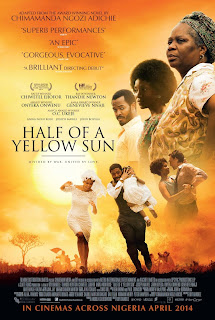
Good news to movie enthusiasts especially those who have been anticipating the release of the screen adaptation of Chimamanda Adichie's award-winning book, Half of a Yellow sun. The movie has finally gotten a greenlight by the National Film & Video Censors Board (NFVCB) after months of delay. The Biyi-Bandele directed movie which was classified "18" has been approved for cinema release.
Loladeville blog is a one-stop site for entertainment, sports, fashion and other interesting news.

The last has certainly not been heard of the highly-anticipated movie, Half of a Yellow Sun which was banned in Nigeria by the National Film and Video Censors Board (NFVCB) few months ago for being partly based on events that took place during the Biafran war. Ace filmmaker and cinematographer has joined thousands of people appealing to the board for the release of the movie.


"This is an appeal to the DG of the National Film and Video Classification Board to release the film Half Of A Yellow Sun to the Nigerian public without further delay. Chimamanda Adichie on BBC programme, HardTalk yesterday revealed that HOAYS is not political but a beautiful love story. We understand that the film is already awarded classification and has been cleared by appropriate security agencies. Nigeria cannot afford another round of negative press and global condemnation before taking action. Please madam let's do the right thing at the right time." He wrote on his official twitter page.
Loladeville blog is a one-stop site for entertainment, sports, fashion and other interesting news.

Just like award-winning novel, Half of a Yellow Sun, renowned author, Chimamanda Ngozi Adichie's third novel – Americanah is about to be adapted on the big screen. Kenyan movie star, Lupita Nyong'o has obtained film rights for the movie version of the book.

The announcement was made yesterday May 29, 2014 at Stylist Magazine's Stylist Book Club Inaugural Session held at the Waldorf Hilton in UK.


"Lupita Nyong'o has optioned rights for the film version of Americanah, Chimamanda Ngozi Adichie confirms #stylistbookclub". Stylist Magazine wrote on its twitter account and also posted photos of the writer signing copies of Americanah for her fans.

Loladeville blog is a one-stop site for entertainment, sports, fashion and other interesting news.

I was woken by the pilot's voice. In the drowsy hum of the airplane, his words crackled, and I thought I heard something about preparing to land. Could I have slept so long? I looked at the time. It was only three hours into the Lagos-to-Atlanta flight. The flight attendants were hurrying back and forth. The pilot was still speaking.

"We have an emergency onboard and we have had to divert the flight to Dakar." I could feel the plane descending. It seemed too fast. A sweeping hollowness. My fog of sleep cleared instantly. Something was wrong, the pilot was too cryptic, the flight attendants too blank-faced, snatching up cups, urging seats straight. I thought: If I die, I hope it's quick and I don't know. The woman beside me crossed herself. Then the pilot's voice came back on. It was a medical emergency, he said; a pregnant passenger went into early labor and had just had a baby. I sensed, around me, a collective hush of relief and wonder. A baby delivered on the plane! We landed in Dakar. It was 2 a.m. Medical personnel in orange vests hurried in, a man carrying a black box, a lanky woman dragging an IV stand, their eyes heavy with sleep. I wondered what the baby would need, and if they had what the baby would need.

Soon, the lanky woman left, cradling a bundle wrapped in cloth. The baby. I strained to see better, hoped I would hear it cry. Then the new mother emerged, a young woman with a tube dangling from her arm, and behind her came the other medical worker, trying to support her. But she didn't need him. She strode past, straight and steady, so quick that I caught only a glimpse of her face. She looked stunned and frustrated. It seemed even more of a wonder to me, not only that she had just had a baby in midair but that there she was on her feet, normal and capable. The pilot came out of his cabin. A tall man with an easy air, he told us it was a baby boy, and both mother and baby were fine.

His American humor emerged. "Been flying a long time and this is a first for me!". We, the Nigerian passengers, laughed with a shared sense of delight, as though by being present we had  somehow shared in bringing this baby into the world. The American flight attendants were baffled.

"The mother said she was 24 weeks gone, but that baby looked full-term. Why would anybody take the risk?" one asked. We did not ask why. The new mother was travelling alone, nobody knew her, and yet we felt as if we did. We speculated about her circumstances. She probably had visa problems, got her visa later that she'd planned, or perhaps she had not planned it early enough, or maybe the chance to go to America emerged late in her pregnancy, and she'd chosen to do what she had to do because the sparkling worthwhile end was an American-born baby.  I thought of her expression as she exited the plane, more frustration than worry, a lament for the American passport that now would not be. Some passengers joked about her poor luck.

"Now she has a Senegalese baby, ah, this is bad market for the baby!" one said. "A Senegalese passport is still better than a Nigerian," another countered.

"They will give a Senegalese person a visa before giving a Nigerian." "Good that the baby waited for the flight to take off, do we even have the right emergency services in Lagos airport?" someone else asked. We chuckled. Good will swirled among us.

Thank God it ended well, many people said, thank God. Risk taking was familiar to us. For too many in our world, this was the norm: the lack of choice and the dependence on chance. Again, the pilot's voice brought news. A tire had  deflated, and the airline did not have the resources in Senegal to fix it in time. We would have to spend the night in Dakar. As we left the plane and got into buses, we sent text messages and grumbled about the inconvenience of arriving a day later than planned. Still, the complaints were light-footed because what mattered was that the birth had gone well. In the hotel, some passengers posed for pictures by the fountain; why miss a good photo opportunity in a fellow African city they otherwise might never have visited?

"Please, my sister, do you have any sleeping pills?" a stranger asked me.

The next morning, slightly disoriented and starved of sleep, I skipped breakfast. When I finally went down to the lobby, most of the crew and passengers were gathered, waiting for the airport bus, faces dull and unrefreshed, voices a muted murmuring. As I joined the group, a woman asked me if I had heard.

"Heard what?" I asked.

"The baby died."


*********************************************************************************
Chimamanda Ngozi Adichie is a renowned novelist, the author of three novels, Purple Hibiscus (2003), Half of a Yellow Sun (2006), and Americanah (2013), of a short story collection, The Thing around Your Neck (2009).  She has received numerous awards and distinctions, including the Orange Broadband Prize for Fiction (2007) and a MacArthur Foundation Fellowship (2008).


*********************************************************************************
Are you a writer? Interested in sharing your short stories on this platform? Be our guest on our Short Story Fridays segment.

Email: ololade.olatunji@yahoo/gmail.com